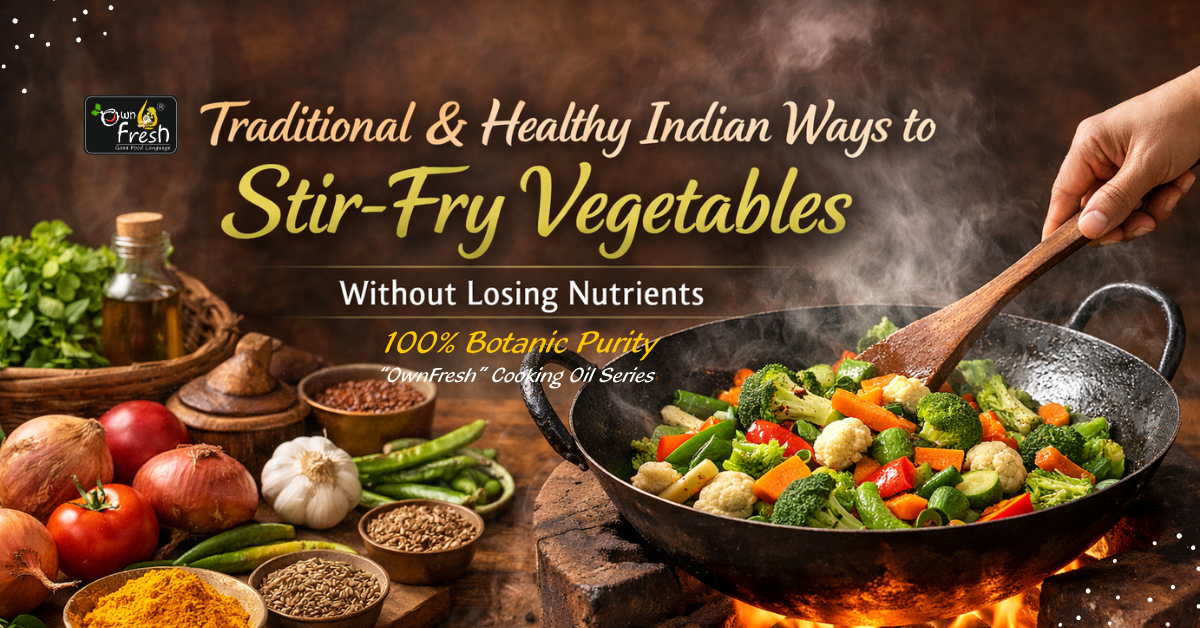
Stir-frying vegetables is a daily activity in most Indian kitchens. From a simple cabbage sabzi to mixed vegetable stir-fries made for lunchboxes, this cooking method is valued for its speed, taste, and freshness. Yet, many home cooks often wonder whether stir-frying destroys nutrients, or whether the oil used makes the dish less healthy.
The truth is that stir-frying can be one of the most nutritious ways to cook vegetables when done correctly. The key lies not just in the vegetables themselves, but in how they are cooked, the heat used, and most importantly, the choice of cooking oil.
At OwnFresh, we believe that traditional Indian cooking methods hold deep wisdom. When paired with the right oils and simple techniques, they allow vegetables to retain colour, crunch, and nutrition, while still delivering satisfying flavour.
This blog explores how Indian households can stir-fry vegetables in a healthier way by understanding oil selection, heat control, and time-tested cooking practices.
Table of Contents
Why oil selection matters while stir-frying vegetables
Oil is often seen as something that only adds taste or prevents food from sticking to the pan. In reality, oil plays several important roles during stir-frying.
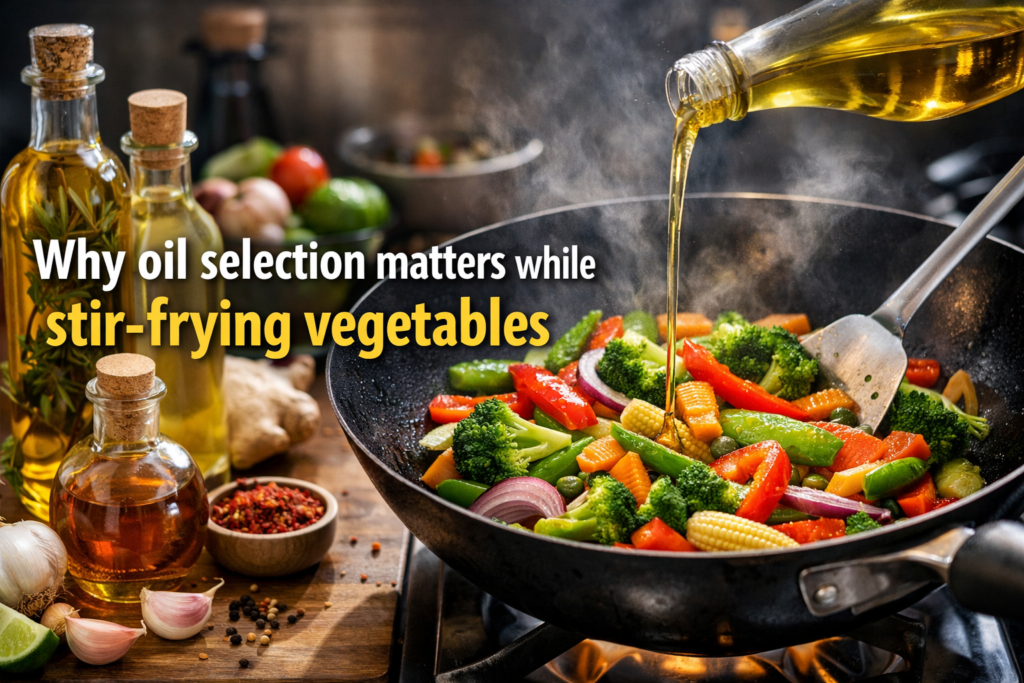
First, oil acts as a medium that transfers heat evenly to vegetables. This allows them to cook quickly without burning. Second, oil helps release flavours from spices, seeds, and aromatics like garlic and ginger. Third, certain nutrients present in vegetables need fat to be absorbed properly by the body.
If the oil used is unstable at high heat, it can break down quickly, affect taste, and reduce the nutritional quality of the food. On the other hand, an oil that suits Indian cooking temperatures supports both flavour and nourishment.
This is why traditional Indian kitchens always paid attention to which oil was used for which dish. Stir-frying was never random. It followed experience passed down through generations.
What happens to nutrients when vegetables are cooked at high heat
Vegetables are rich in vitamins, minerals, fibre, and natural plant compounds. Some of these nutrients are sensitive to heat, water, or prolonged cooking.
When vegetables are cooked at very high temperatures for too long:
- Certain heat-sensitive vitamins may reduce
- Natural colour can fade
- Texture may become soft or mushy
- Flavour can turn dull
However, this does not mean that all cooking destroys nutrition. In fact, proper stir-frying can preserve more nutrients than boiling, because vegetables are cooked quickly and with minimal water.
The key is controlling three things:
- Temperature
- Cooking time
- Oil stability
Indian stir-frying traditionally focuses on medium to high heat for a short duration, which helps lock in nutrients while enhancing taste.
Understanding smoke point in simple terms
Smoke point is a term that often causes confusion. Simply put, it is the temperature at which an oil starts to smoke visibly.
When oil reaches its smoke point:
- It begins to break down
- Flavour changes
- Nutritional quality reduces
- Unpleasant compounds may form
For stir-frying, oil should be heated enough to cook vegetables quickly, but not so much that it smokes heavily.
Traditional Indian cooking rarely involves heating oil until it smokes aggressively for long periods. Instead, oil is heated just enough to release aroma from spices and then vegetables are added promptly.
Understanding smoke point helps home cooks choose oils that remain stable during this process.
Why traditional oils suit Indian stir-frying styles
Indian stir-frying is different from some other cuisines. It often involves:
- Tempering spices in oil
- Cooking vegetables quickly
- Using moderate to high heat
- Finishing dishes within a short time
Traditional oils were naturally suited to these techniques.
Oils such as groundnut oil, sesame oil, mustard oil, and coconut oil have been used in Indian kitchens for generations. Each oil has its own character, aroma, and heat tolerance.
These oils were chosen not because of labels or trends, but because they worked well with Indian cooking styles and local ingredients.
They provided:
- Stability during cooking
- Compatibility with spices
- Support for digestion when used correctly
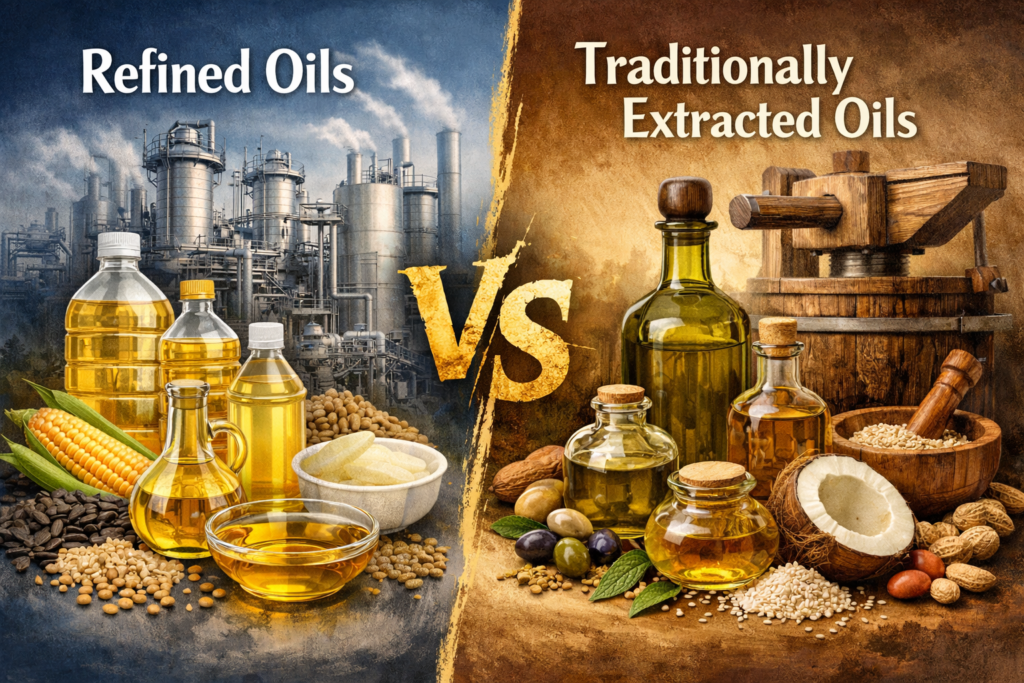
Refined oils and traditionally extracted oils compared
Understanding the difference between refined and traditionally extracted oils helps in making better choices.
Processing differences
Traditionally extracted oils are made using mechanical pressing methods that involve limited processing. The oil retains much of its natural character.
Refined oils go through multiple stages such as high heat treatment, deodorising, and bleaching to achieve uniform colour and neutral taste.
Behaviour during stir-frying
Traditionally extracted oils tend to hold their structure well during Indian cooking temperatures when used properly.
Refined oils may tolerate high heat, but they often lack natural flavour and character. They are designed more for industrial consistency than home-style cooking.
Impact on taste and aroma
In stir-frying, oil contributes to the final taste of vegetables. Traditional oils enhance flavour naturally, while refined oils remain neutral.
This is why a simple bhindi stir-fry tastes different depending on the oil used, even if all other ingredients are the same.
The role of oil in nutrient absorption
Some nutrients found in vegetables are fat-soluble. This means they are better absorbed by the body when consumed with a small amount of fat.
Stir-frying vegetables with the right amount of oil helps:
- Improve absorption of certain nutrients
- Enhance mouthfeel and satisfaction
- Reduce the need for excessive seasoning
This does not mean adding large quantities of oil. Indian home cooking traditionally uses oil thoughtfully, not excessively.
A well-cooked stir-fry uses just enough oil to support cooking and nutrition, without making the dish heavy.
How heat control protects vegetable nutrition
Heat itself is not the enemy. Uncontrolled heat is.
Indian stir-frying uses a balance of heat and movement. Vegetables are added to hot oil, stirred continuously, and cooked for a short time.
This approach:
- Preserves crunch
- Maintains colour
- Prevents nutrient loss
- Keeps flavours fresh
Covering vegetables and cooking them for long periods on high heat can trap steam and overcook them. Traditional methods often avoid this for stir-fries.
Step by step traditional Indian stir-fry method
Below is a simple, traditional approach that many Indian households follow, even if unconsciously.
Step 1. Prepare vegetables before heating the pan
Cut vegetables evenly so they cook at the same pace. This reduces cooking time and prevents overexposure to heat.
Wash and dry vegetables properly. Excess water can lower pan temperature and cause steaming instead of stir-frying.
Step 2. Heat the pan and add oil
Use a heavy-bottomed pan or kadhai. Heat it first, then add oil.
The oil should warm up but not smoke excessively. A gentle shimmer is enough.
Step 3. Temper spices carefully
Add whole spices like mustard seeds, cumin seeds, or curry leaves. Let them release aroma.
This step flavours the oil, which then coats the vegetables evenly.
Step 4. Add vegetables and stir continuously
Add vegetables quickly and stir to coat them in oil.
Keep the flame medium to high, depending on the vegetable. Continuous stirring prevents burning and ensures even cooking.
Step 5. Add salt towards the middle
Adding salt too early can draw out moisture and make vegetables soft. Adding it after initial cooking helps retain crunch.
Step 6. Finish quickly and rest briefly
Once vegetables are cooked but still firm, turn off the heat. Let the dish rest uncovered for a minute before serving.
This helps excess steam escape and preserves texture.
Common mistakes Indians make while stir-frying vegetables
Even experienced cooks can unknowingly reduce nutritional value through small habits.
Using too much oil
Excess oil makes vegetables heavy and masks their natural taste.
Cooking on very high heat throughout
High heat is useful at the start, but constant high heat can burn spices and damage vegetables.
Overcrowding the pan
Too many vegetables at once lower the pan temperature and cause steaming instead of stir-frying.
Cooking for too long
Stir-frying is meant to be quick. Prolonged cooking reduces colour, texture, and freshness.
Tips to preserve colour, crunch, and nutrition
Simple adjustments can make a big difference.
- Cut vegetables evenly
- Use fresh vegetables whenever possible
- Heat the pan properly before adding oil
- Avoid covering vegetables while stir-frying
- Use moderate oil quantities
- Finish cooking while vegetables still have bite
These habits align with traditional Indian cooking practices and support better nutrition.
Why Indian cooking wisdom still matters today
Modern kitchens have new appliances and tools, but the basics of cooking remain unchanged.
Indian food traditions evolved through observation. People noticed which methods kept food satisfying, digestible, and nourishing.
Stir-frying vegetables using stable oils, controlled heat, and short cooking times is one such wisdom.
In today’s fast-paced life, returning to these basics helps families eat better without complicated rules or extreme changes.
Choosing the right oil for different vegetables
Different vegetables respond differently to heat.
- Leafy vegetables cook quickly and need gentle heat
- Root vegetables need slightly more time
- Hard vegetables like beans or carrots benefit from cutting thinly
Using oils that suit medium to high heat and complement vegetable flavour helps maintain balance.
Indian kitchens traditionally matched oil choice with vegetables and spices, even if not consciously labelled.
The balance between taste and health in stir-frying
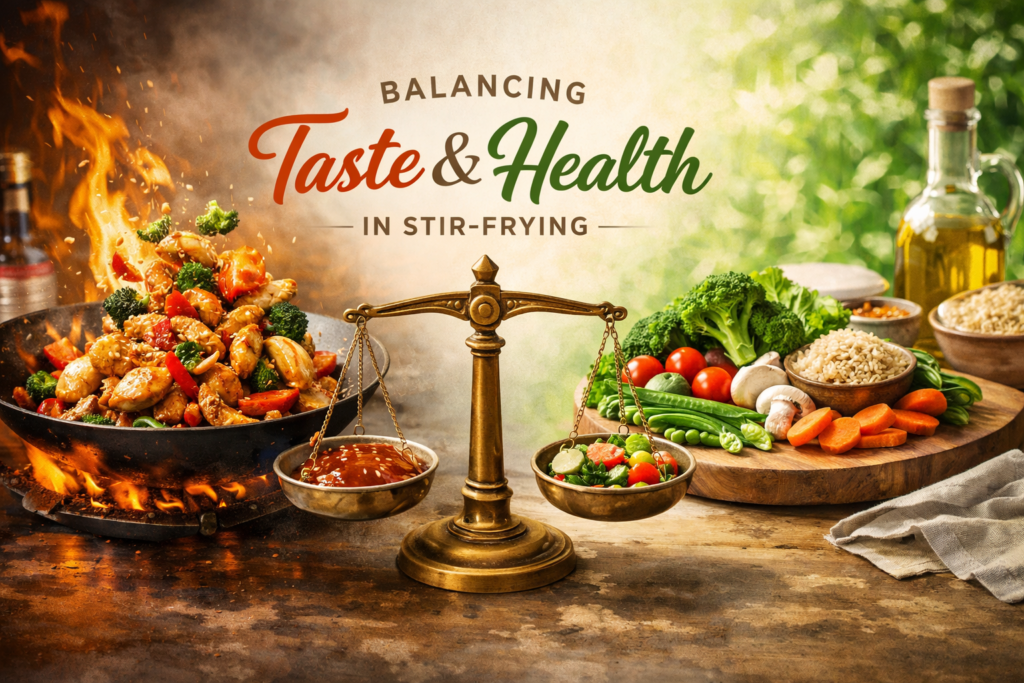
Healthy food should not feel like a compromise. Stir-fried vegetables, when done right, are colourful, flavourful, and satisfying.
Taste encourages regular consumption of vegetables. When vegetables taste good, families eat them more often.
Using the right oil supports this balance by enhancing flavour while supporting nutrition.
Stir-frying as a daily cooking practice
Stir-frying is practical. It saves time, preserves ingredients, and adapts to seasonal vegetables.
This is why it remains a daily practice in Indian homes, from simple tinda sabzi to mixed vegetable stir-fries served with dal and roti.
By understanding oil behaviour, heat control, and cooking flow, home cooks can make this everyday practice even better.
How ingredient quality affects final nutrition
Fresh vegetables, clean spices, and good quality oil work together.
If one element is weak, the dish suffers.
Traditional cooking depended on ingredient quality because there were no shortcuts. This awareness is still relevant today.
At OwnFresh, this respect for ingredients shapes how food is viewed — simple, honest, and rooted in everyday wellness.
Bringing mindful cooking back into Indian kitchens
Mindful cooking does not mean slow cooking every meal. It means being aware of how food is prepared.
Stir-frying vegetables mindfully involves:
- Paying attention to heat
- Choosing suitable oil
- Cooking just enough
- Respecting ingredients
These small actions support both taste and nourishment.
Stir-frying vegetables for all age groups
Well-cooked stir-fried vegetables suit children, adults, and elders when prepared gently.
Softening vegetables slightly for elders, reducing spice for children, and using balanced oil quantities ensures that everyone benefits.
This adaptability is why stir-frying remains relevant across generations.
Conclusion
Stir-frying vegetables is not just a cooking method. It is a reflection of Indian kitchen wisdom.
By choosing stable, traditionally used oils, controlling heat, and respecting cooking time, vegetables can retain their nutrients, colour, and flavour.
These practices do not require special equipment or complicated techniques. They only require awareness and care.
In everyday Indian cooking, such mindful approaches help families eat better while enjoying food the way it was meant to be enjoyed.
Frequently asked questions
Is stir-frying vegetables healthy for daily meals?
Yes. When done with proper oil choice, moderate heat, and short cooking time, stir-frying is suitable for daily meals.
Does high heat destroy all nutrients in vegetables?
No. Short cooking at controlled heat preserves many nutrients better than long boiling.
How much oil is enough for stir-frying vegetables?
A small amount that coats the pan and vegetables evenly is sufficient. Excess oil is unnecessary.
Which oil is best for Indian-style vegetable stir-frying?
Oils traditionally used in Indian kitchens that remain stable at cooking temperatures work well for stir-frying.
Why do vegetables lose colour while cooking?
Overcooking, excess water, or low pan temperature can cause colour loss.
Should vegetables be covered while stir-frying?
Usually no. Covering traps steam and can make vegetables soft instead of crisp.
Can stir-fried vegetables be prepared in advance?
They are best eaten fresh, but can be prepared slightly ahead and reheated gently.