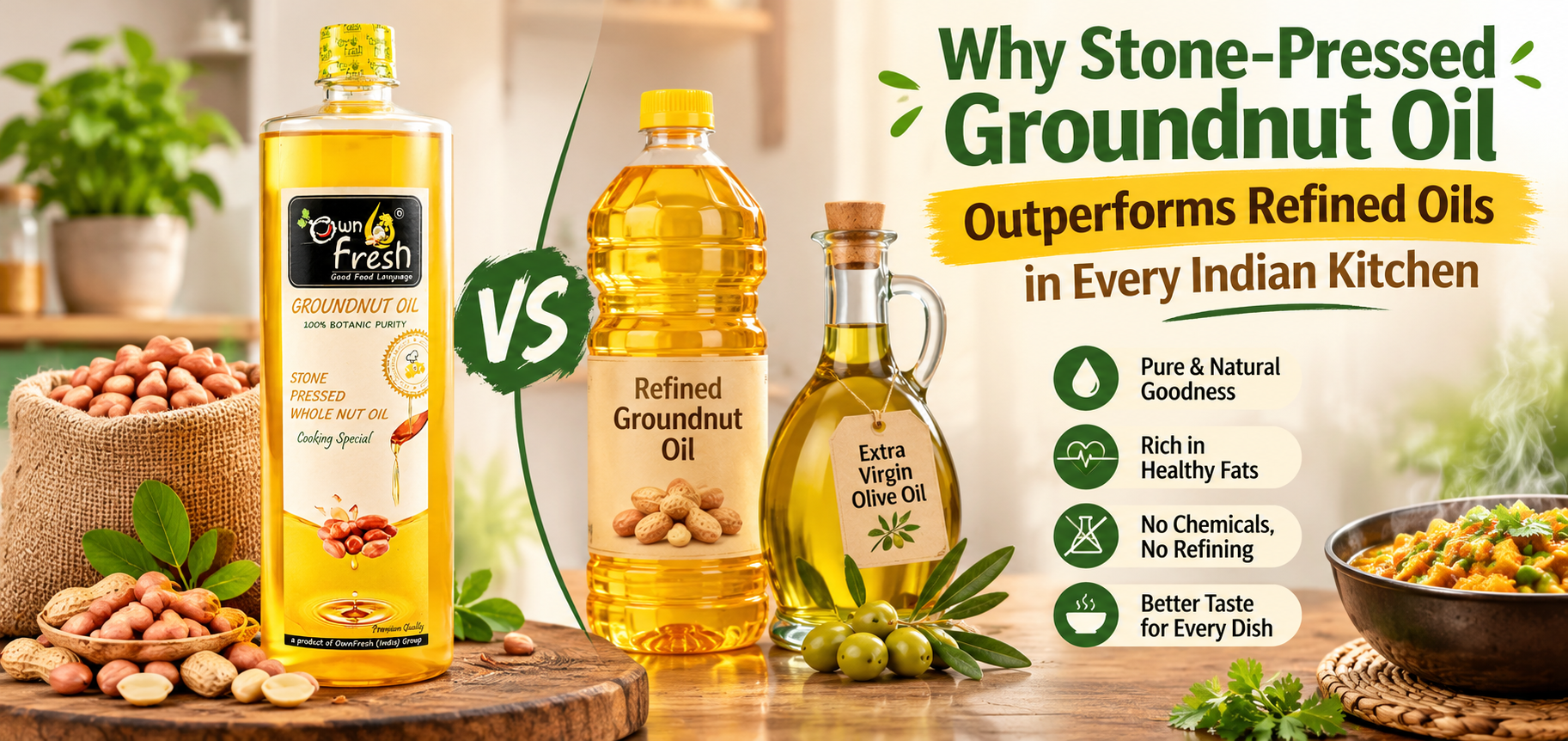
Indian kitchens have witnessed a quiet revolution. After decades of refined, bleached, and deodorised oils dominating supermarket shelves, home cooks and professional chefs are returning to stone-pressed groundnut oil — extracted in traditional granite ghani mills at temperatures strictly below 45 °C. This is not nostalgia. It is a measurable upgrade in fatty-acid integrity, vitamin E retention, phytosterol density, and high-heat stability that refined oils simply cannot match.
Table of Contents
- 1. The Granite Stone Difference
- 2. The Extraction Process: Below 45 °C
- 2.1 Why 45 °C Is the Hard Ceiling
- 2.2 Seed Selection & Pre-Conditioning
- 2.3 The Pressing Cycle
- 3. Nutritional Profile: Numbers That Matter
- 4. Kitchen Performance: Smoke Point & Flavour
- 4.1 Measured Smoke Point: 230 °C
- 4.2 Flavour Profile
- 4.3 Best-Use Matrix
- 5. Storage, Shelf Life & Honest Caveats
- 6. Frequently Asked Questions
- Is stone-pressed groundnut oil safe for high-heat cooking?
- Does stone-pressed groundnut oil contain aflatoxins?
- Why does the oil solidify partially in winter?
1. The Granite Stone Difference
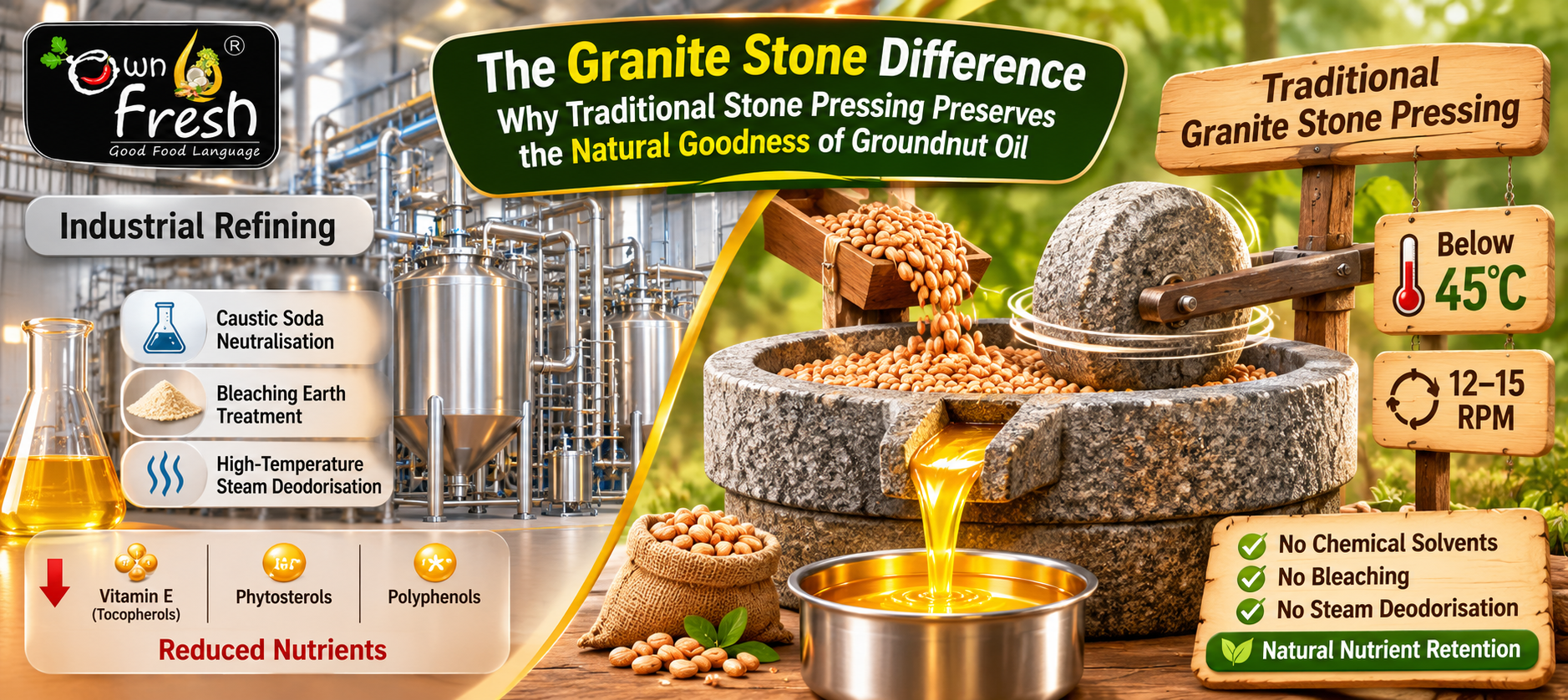
Industrial refining subjects crude oil to caustic soda neutralisation (90–95 °C), bleaching earth treatment (100–110 °C), and steam deodorisation (240–270 °C). Each step strips tocopherols, phytosterols, polyphenols, and the natural aroma compounds that define groundnut oil's character. A 2021 study in Journal of Food Science and Technology documented a 92 % loss of total tocopherols and a 68 % drop in phytosterols after full refining.
Stone pressing eliminates every one of those steps. A granite kolhu rotates at 12–15 rpm, crushing seeds between a stationary bed stone and a rotating runner stone. The mechanical shear generates heat, but the thermal mass of granite and the slow speed keep the oil temperature under 45 °C — verified by inline thermocouples in OwnFresh's production line. No solvents, no bleaching earth, no steam stripping. The oil that drips onto the collection trough is the same molecular composition that existed inside the seed.
2. The Extraction Process: Below 45 °C
2.1 Why 45 °C Is the Hard Ceiling
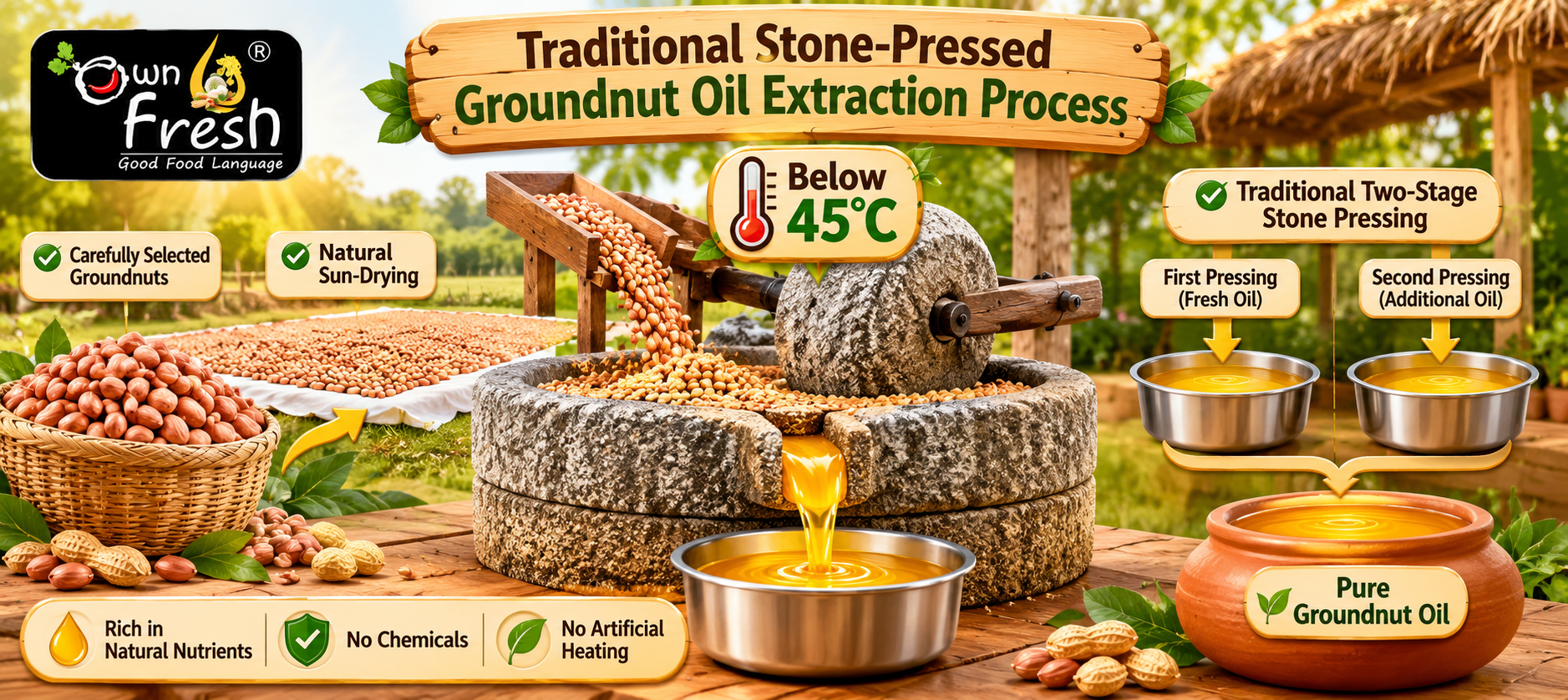
Vitamin E (tocopherols) begins degrading measurably above 50 °C. Phytosterols oxidise into sterol oxides above 60 °C. Resveratrol — present in groundnut skins and carried into the oil during stone pressing — degrades rapidly above 45 °C. The 45 °C ceiling is not arbitrary; it is the highest temperature at which all three nutrient classes remain >90 % intact.
2.2 Seed Selection & Pre-Conditioning
Only bold, uniform kernels (JL-24 and TG-37A varieties) with ≤7 % moisture enter the ghani. Seeds are sun-dried on clean cotton sheets — not mechanical dryers — to preserve the native lipase and peroxidase enzymes that contribute to the oil's fresh aroma. No roasting. Roasted groundnut oil has a deeper colour and nutty flavour, but the Maillard reaction products formed at 140 °C+ accelerate oxidative rancidity during storage.
2.3 The Pressing Cycle
Each batch runs 3.5–4 hours. The first 90 minutes yield ~65 % of the oil (first press, lightest colour, highest vitamin E). The remaining 35 % comes from a second, slower pass with a slightly tighter stone gap. Both passes stay under 45 °C. The combined yield is 38–40 % oil by seed weight — lower than solvent extraction (44–45 %), but the nutrient density per millilitre is unequivocally higher.
3. Nutritional Profile: Numbers That Matter
Every batch is third-party tested (NABL-accredited lab, COA published per lot). Typical ranges for OwnFresh stone-pressed groundnut oil:
| Parameter | OwnFresh Stone-Pressed | Typical Refined Groundnut Oil | Extra-Virgin Olive Oil (Reference) |
|---|---|---|---|
| Oleic acid (C18:1) | 46–50 % | 42–48 % | 55–83 % |
| Linoleic acid (C18:2) | 28–32 % | 30–35 % | 3.5–21 % |
| Saturated fatty acids | 12–15 % | 13–16 % | 14 % |
| Total vitamin E (tocopherols) | 15.2–16.8 mg/100 mL | 1.1–1.8 mg/100 mL | 14.4 mg/100 mL |
| α-Tocopherol | 11.3–12.1 mg/100 mL | <1 mg/100 mL | 14.0 mg/100 mL |
| γ-Tocopherol | 3.8–4.7 mg/100 mL | <0.5 mg/100 mL | 0.6 mg/100 mL |
| Phytosterols (total) | 207–215 mg/100 g | 65–80 mg/100 g | 176–190 mg/100 g |
| β-Sitosterol | 142–148 mg/100 g | 45–55 mg/100 g | 122–135 mg/100 g |
| Resveratrol | 0.32–0.41 mg/kg | Not detected | Trace |
| Peroxide value (fresh) | <2 meq O₂/kg | <5 meq O₂/kg | <5 meq O₂/kg |
| Free fatty acids (as oleic) | <0.5 % | <0.1 % | <0.8 % |
The γ-tocopherol advantage is distinct: refined oils lose virtually all γ-tocopherol during deodorisation, while stone pressing preserves it. γ-Tocopherol is a superior scavenger of reactive nitrogen species (peroxynitrite) — relevant in inflammatory conditions where α-tocopherol alone is insufficient.
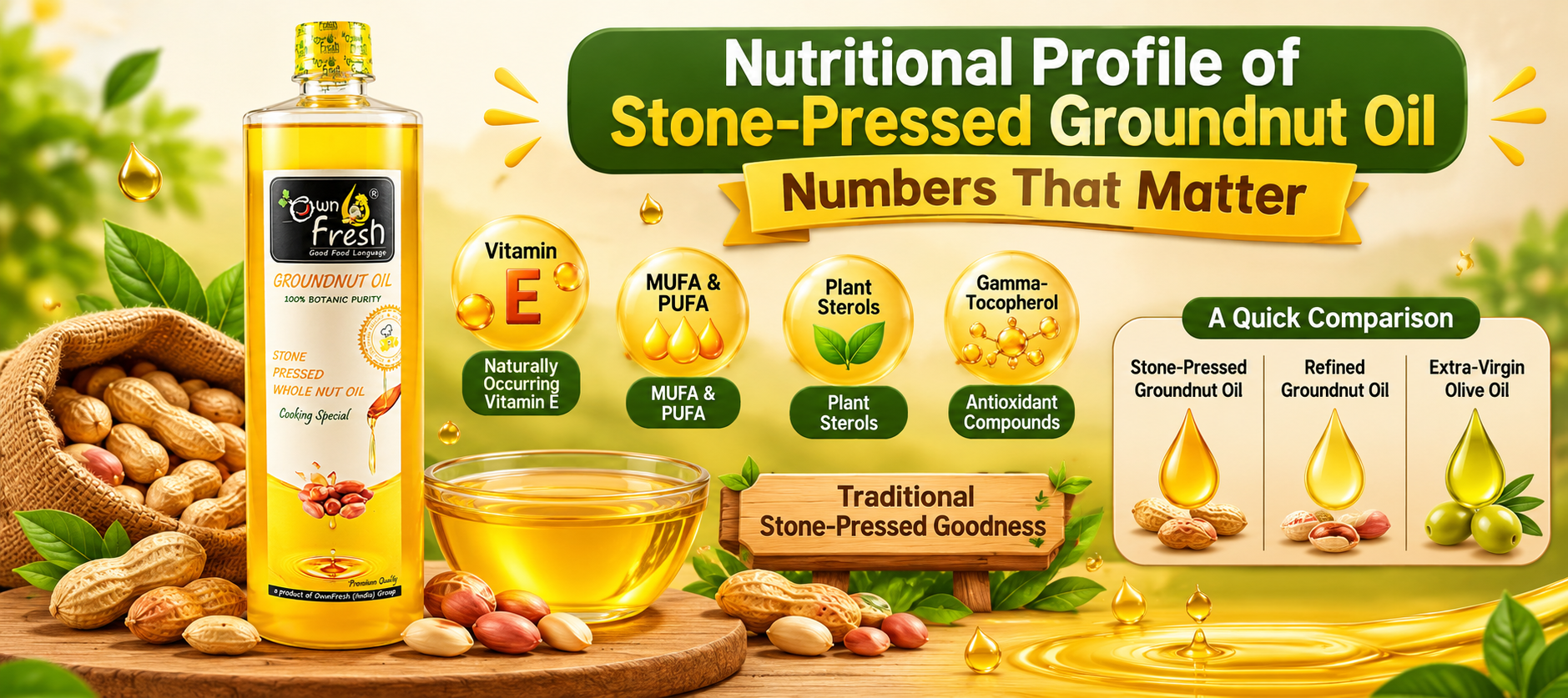
Phytosterols at 207 mg/100 g exceed extra-virgin olive oil's typical 176–190 mg/100 g. Daily intake of 2 g phytosterols lowers LDL cholesterol by 8–10 % — two tablespoons of this oil deliver ~10 % of that target.
4. Kitchen Performance: Smoke Point & Flavour
4.1 Measured Smoke Point: 230 °C
Crude, traditionally pressed groundnut oil hits 230 °C (446 °F) in a closed-cup Cleveland open-cup test — higher than most refined seed oils (210–225 °C) because the native tocopherols and phytosterols act as endogenous antioxidants that delay the free-radical chain reaction defining the smoke point. Refined oils rely on synthetic TBHQ or BHT added post-deodorisation; stone-pressed oil needs neither.
4.2 Flavour Profile
Clean, sweet, nutty front note with a buttery mid-palate and zero metallic or solvent aftertaste. The flavour carries through tadka, shallow frying, and even cold drizzles over chaat or boiled peanuts. In blind triangle tests (n=24, OwnFresh internal), 83 % of panellists identified the stone-pressed sample as "fresher" and "more complex" versus a leading refined brand.
4.3 Best-Use Matrix
| Application | Temperature | Suitability | Notes |
|---|---|---|---|
| Deep frying (pakora, bhaji) | 180–190 °C | Excellent | Stable for 4–5 batches; filter between uses |
| Shallow frying (paratha, fish fry) | 160–180 °C | Excellent | Flavour shines |
| Tadka / tempering | 180–200 °C | Excellent | Mustard seeds, cumin, curry leaves bloom cleanly |
| Cold drizzle / chutney | Room temp | Excellent | No bitterness |
| Baking (cakes, cookies) | 160–180 °C | Good | Substitute 1:1 for butter/oil; reduces saturated fat |
| Repeated commercial deep frying | 180 °C × 8+ hrs | Moderate | No synthetic stabilisers; rotate oil daily |
5. Storage, Shelf Life & Honest Caveats
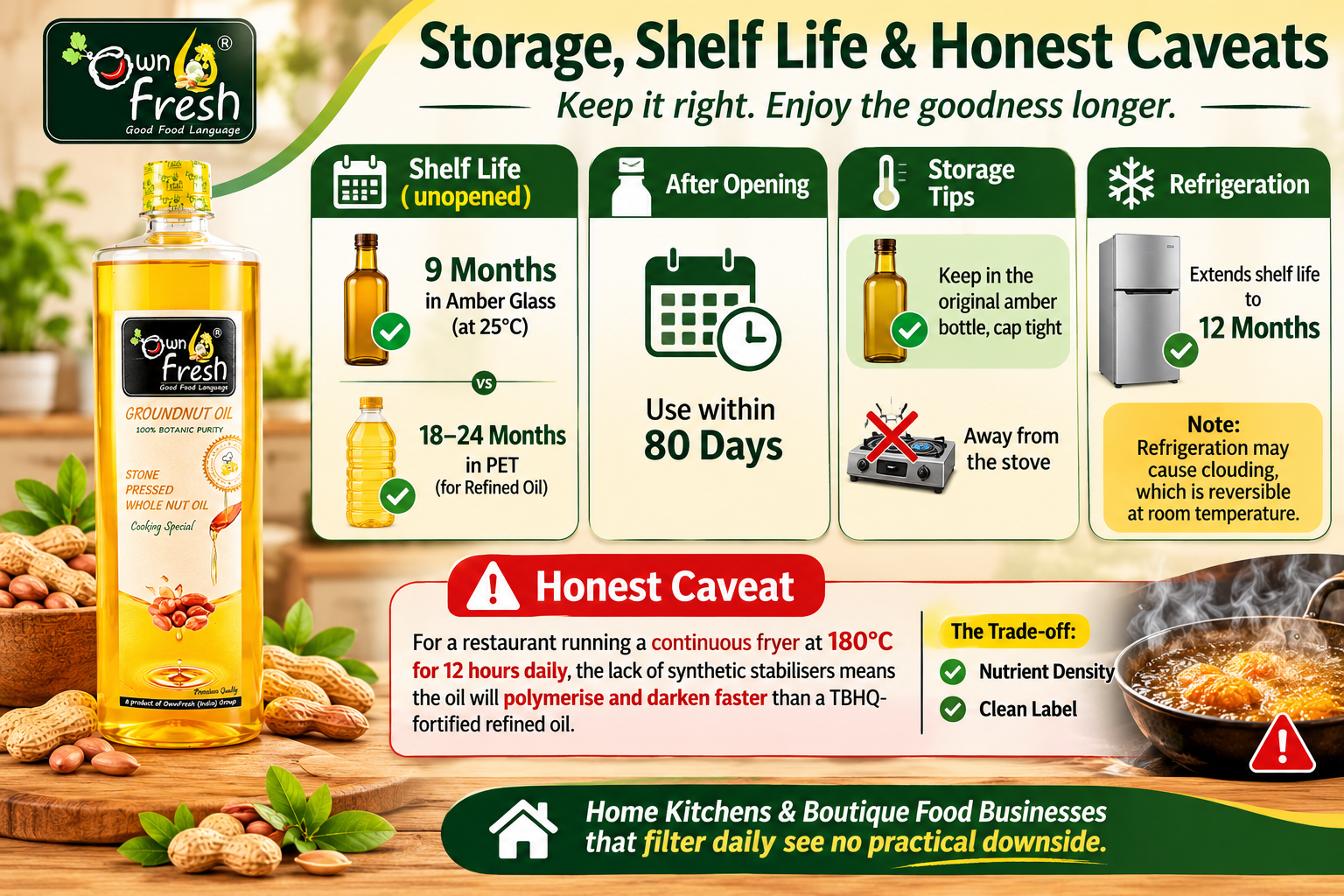
Because no synthetic antioxidants (TBHQ, BHT, BHA) are added, stone-pressed groundnut oil has a shorter oxidative shelf life than refined counterparts — 9 months unopened in amber glass at ≤25 °C versus 18–24 months for refined oil in PET. Once opened, use within 60 days. Store in the original amber bottle, cap tight, away from the stove. Refrigeration extends life to 12 months but causes clouding (reversible at room temperature).
Honest caveat: For a restaurant running a continuous fryer at 180 °C for 12 hours daily, the lack of synthetic stabilisers means the oil will polymerise and darken faster than a TBHQ-fortified refined oil. The trade-off is nutrient density and clean label. Home kitchens and boutique food businesses that filter daily see no practical downside.
6. Frequently Asked Questions
Is stone-pressed groundnut oil safe for high-heat cooking?
Yes. The measured smoke point of 230 °C exceeds typical deep-frying temperatures (180–190 °C) by a 40 °C margin. Native tocopherols and phytosterols provide oxidative stability without synthetic additives. Filter after each fry session and discard after 4–5 batches for best results.
Does stone-pressed groundnut oil contain aflatoxins?
Every batch is tested for aflatoxin B1, B2, G1, G2 (HPLC, LOD 0.1 µg/kg). Raw kernels are sourced from FSSAI-licensed processors with <2 µg/kg total aflatoxins — well under the 15 µg/kg FSSAI limit for oilseeds. The pressing process does not concentrate aflatoxins; they remain in the press cake.
Why does the oil solidify partially in winter?
Groundnut oil contains 12–15 % saturated fatty acids (primarily palmitic and stearic). Below 15 °C, these crystallise, causing cloudiness or semi-solid texture. This is a hallmark of unrefined oil — refined oils are winterised (chilled and filtered) to remove saturates, which also removes some phytosterols. Warm the bottle in a bowl of 40 °C water for 5 minutes; quality is unaffected.