Namaste and welcome to the OwnFresh family!
If you grew up in an Indian household, the smell of mustard oil is probably a core memory for you. It is that sharp, pungent aroma that fills the kitchen when your mother heats the kadhai for a tadka. It is the golden touch in our mango pickles and the secret ingredient that makes a simple potato fry taste like heaven.
For generations, mustard oil, or sarson ka tel, has been the king of Indian oils. But lately, many of our customers have been asking a very good question: “What is the difference between black mustard oil and yellow mustard oil?”
You might have seen both in the market. One looks dark and smells strong. The other looks lighter and smells milder. But is the difference just in the look and smell? Or does it change how your food tastes and how healthy it is for your heart?
Today, we are going to dive deep into this topic. We will explore every little detail from the seeds they come from to how they behave in your frying pan. We will talk about taste, health, tradition, and which one deserves a spot on your kitchen shelf.
Sit back with a cup of chai, and let’s explore the golden world of mustard oil together.
Table of Contents
Understanding the source: the seeds
The benefits of Black mustard oil
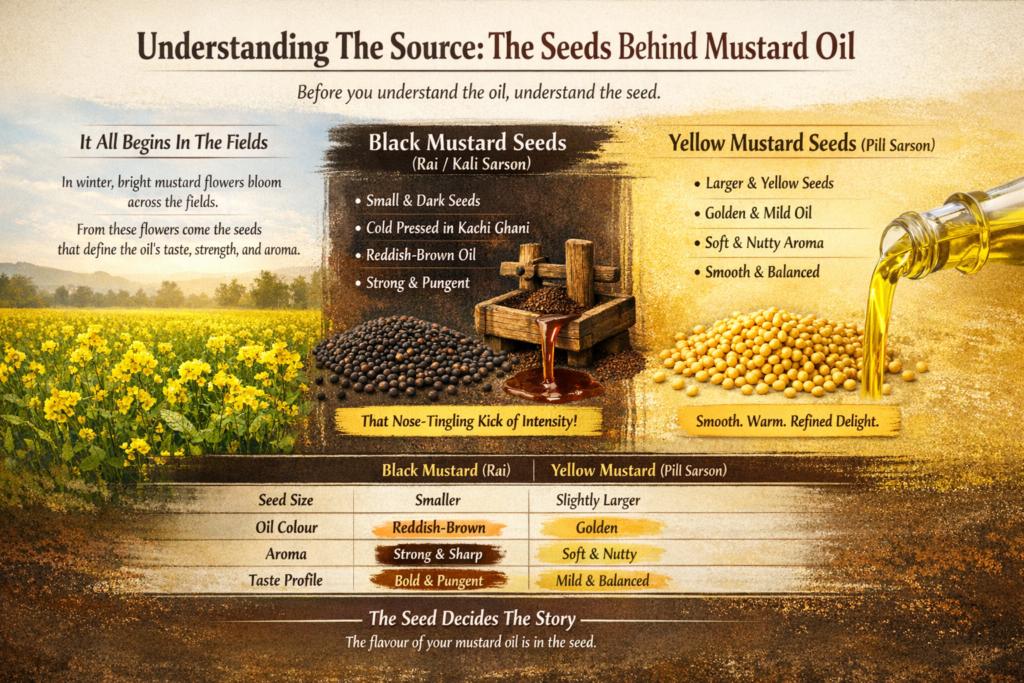
To understand the oil, we first have to understand the seed. It all starts in the fields where the yellow flowers bloom in winter.
Black mustard seeds (rai or sarson)
Black mustard oil comes from black or dark brown mustard seeds. In India, we often call these rai or kali sarson. These seeds are small, dark, and packed with intense flavour.
When these seeds are crushed in a traditional kachi ghani (cold press), they release a dark, reddish-brown oil. This is the oil that has that famous “kick.” If you have ever opened a bottle of fresh black mustard oil and felt a tingle in your nose or tears in your eyes, that is the power of black mustard seeds.
Yellow mustard seeds (pili sarson)
Yellow mustard oil is extracted from yellow mustard seeds, known as pili sarson. These seeds are slightly larger than the black ones and have a creamy yellow coat.
These seeds are generally considered a premium variety in many parts of India. When pressed, they produce an oil that is lighter in texture and golden in colour. It does not have the aggressive punch of the black seeds. Instead, it carries a soft, nutty aroma that is very pleasing to the senses.
The sensory experience: colour, aroma, and taste
When you are cooking for your family, you are not just providing nutrition; you are creating an experience. The oil you choose plays a huge role in the colour, smell, and taste of the final dish.
1. The difference in colour
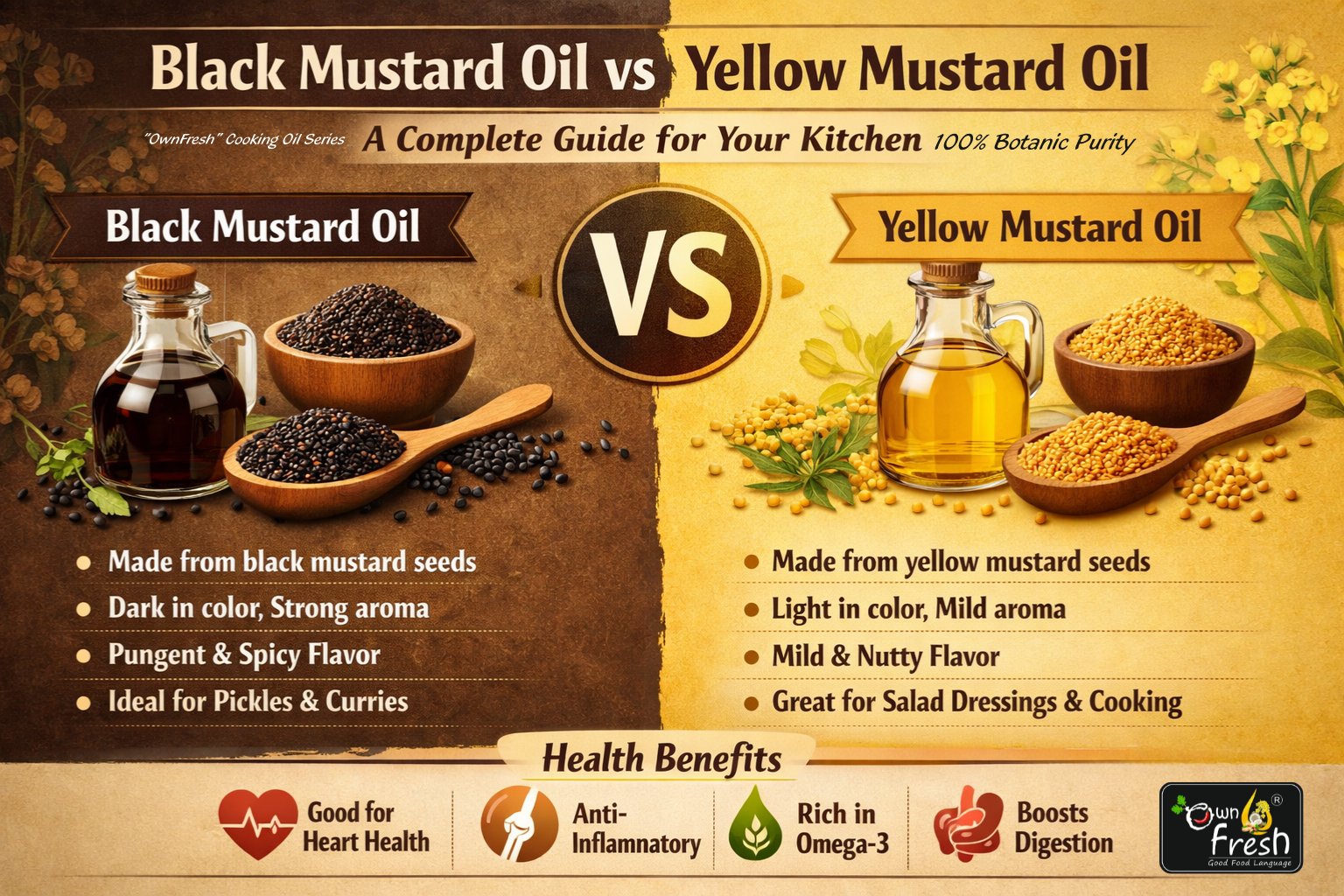
Black mustard oil: This oil typically has a dark, amber-gold colour. Sometimes, it can even look slightly reddish-brown. When you pour it into a pan, it looks heavy and rich. It gives a deep, golden-brown coating to fried foods like fish or pakoras.
Yellow mustard oil: As the name suggests, this oil is much lighter. It is a bright, translucent yellow, almost like sunshine in a bottle. Because it is lighter, it doesn’t darken your food as much as black mustard oil does. If you are making a dish where you want the natural colours of the vegetables to shine through without a heavy dark coat, this oil is beautiful.
2. The difference in aroma
Black mustard oil: This is the “boss” of the kitchen. The aroma is pungent, sharp, and strong. This pungency comes from a natural compound called allyl isothiocyanate.
In many North Indian and Bengali homes, this smell is a sign that good food is being cooked. However, for some people, especially those who are new to mustard oil or prefer milder flavours, this smell can feel a bit overpowering. It usually needs to be heated to the smoking point to reduce this strong smell before adding spices.
Yellow mustard oil: The aroma here is distinct but gentle. It still smells like mustard, but it won’t make your eyes water. It has a sweet, nutty fragrance that lingers pleasantly. You don’t always need to heat it to the smoking point to kill the smell because the smell is already quite appetizing and mild.
3. The difference in taste
Black mustard oil: The taste is spicy and sharp. If you taste a drop raw, it might sting your tongue slightly. This is what we call jhaanjh in Hindi. This sharpness is what cuts through rich, fatty foods and balances spices in heavy curries.
Yellow mustard oil: The taste is subtle. It is delicious and flavorful but lacks the sharp bite. It enhances the taste of the vegetables or meat without dominating the dish. It is excellent for people who want the health benefits of mustard oil but find the traditional taste too strong.
Nutritional aspects: simple and clear
At OwnFresh, we believe that health should not be complicated. You don’t need a science degree to know what is good for your family. Let’s break down the nutrition of both oils in simple terms.
Both black and yellow mustard oils are structurally very similar. They both are excellent sources of healthy fats, but there are minor differences.
Good fats (monounsaturated fatty acids)
Both oils are rich in Monounsaturated Fatty Acids (MUFA). You might have heard doctors say that olive oil is good for the heart because of MUFA. Well, mustard oil is our Indian olive oil!
MUFA helps in:
- Keeping your heart healthy.
- Managing good cholesterol levels.
- Providing sustained energy.
Yellow mustard oil is often slightly higher in MUFA compared to black mustard oil, but the difference is small. Both are heart-friendly choices.
Omega-3 and Omega-6 balance
Our bodies need healthy fats called Omega-3 and Omega-6. However, we need them in the right balance. Many refined oils are full of Omega-6 but have zero Omega-3, which causes inflammation in the body.
Mustard oil (both black and yellow) has a fantastic ratio of Omega-3 to Omega-6. This is rare in cooking oils.
- Omega-3 (Alpha-linolenic acid): This reduces inflammation and is great for joint pain and heart health.
- Omega-6: Essential for brain function.
Because yellow mustard oil is often made from a specific high-quality variety of seeds, it is sometimes found to have a slightly better retention of these delicate nutrients, especially if it is Stone-Pressed (kachi ghani).
Natural antioxidants
Yellow mustard oil typically retains more natural antioxidants like Vitamin E. Since the seeds are not as harsh, the extraction process often preserves these delicate vitamins better. Antioxidants are the soldiers that fight aging and keep your cells fresh.
Antibacterial and antifungal properties
Here, black mustard oil often wins. The same compound that gives it that strong smell (allyl isothiocyanate) is a powerful germ killer.
- It helps fight gut infections.
- It is great for pickling because it prevents fungus and bacteria from spoiling the pickle.
- It clears congestion when rubbed on the chest.
Yellow mustard oil also has these properties, but they are milder, just like its taste.
Impact on heart health and overall wellbeing
We know that heart health is a major concern for every Indian family today. With changing lifestyles, choosing the right cooking medium is the first step towards a healthy heart.
Cholesterol management
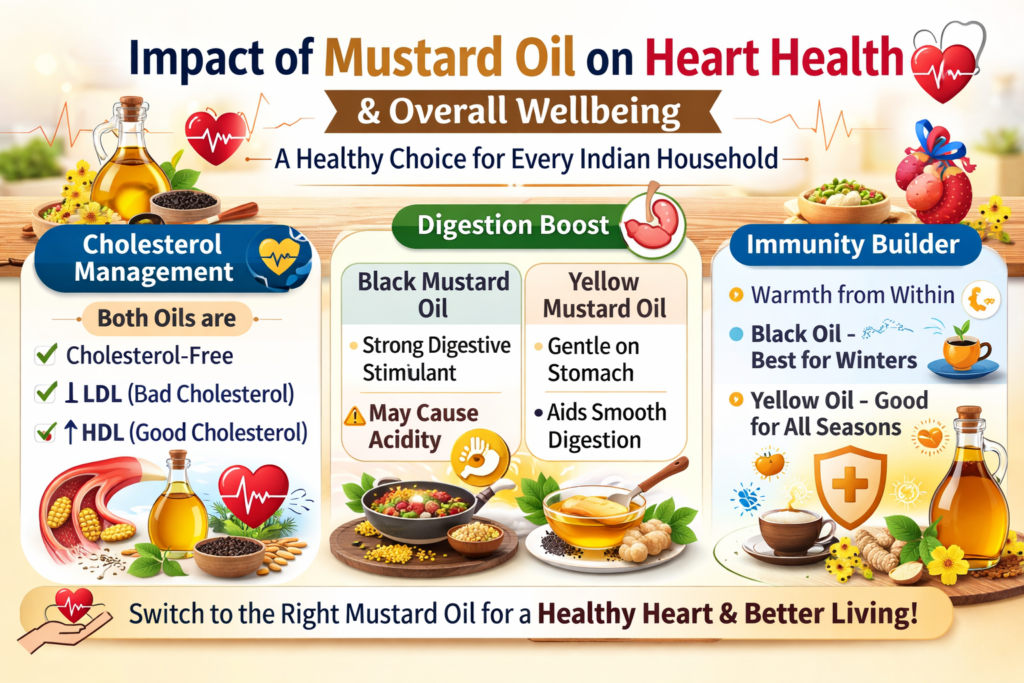
Both oils are free from bad cholesterol. In fact, regular consumption of Stone-Pressed mustard oil has been linked to lower levels of LDL (bad cholesterol) and higher levels of HDL (good cholesterol).
Because yellow mustard oil is lighter and non-sticky, many nutritionists recommend it for people with sensitive digestion or those who feel “heavy” after eating food cooked in black mustard oil.
Digestion boost
Have you ever felt that food cooked in mustard oil digests faster? That is because mustard oil stimulates the production of digestive juices in your stomach.
- Black mustard oil: Very strong stimulant. It really gets the digestion moving, but can sometimes cause acidity in people with sensitive stomachs due to its heat.
- Yellow mustard oil: Acts as a gentle digestive aid. It helps digestion without irritating the stomach lining.
Immunity builder
In Ayurveda, mustard oil is considered a “warming” oil. It keeps the body warm from the inside.
- During winter, cooking in black mustard oil helps ward off coughs and colds.
- Yellow mustard oil provides similar warmth but is considered lighter on the system, making it suitable for year-round use, even in summers.
Traditional usage in Indian cooking
India is a land of diverse flavours, and the use of mustard oil changes as you travel from East to North.
The Bengal connection
In West Bengal and Odisha, black mustard oil is almost a religion. The cuisine relies heavily on the pungent kick of the oil.
- Fish fry: You cannot make a traditional Bengali fish fry without the sharp aroma of black mustard oil. The oil masks the raw smell of the fish and adds a crispy, golden layer.
- Bhorta/Chokha: In mashed dishes like Aloo Bhorta or Baingan Bhorta, raw black mustard oil is drizzled on top at the end. The raw punch is the main flavour maker.
The North Indian tadka
In Punjab, Haryana, and Uttar Pradesh, mustard oil is the primary cooking medium for vegetables (sabzi).
- Sarson da saag: This classic dish tastes best when cooked in dark, pungent mustard oil.
- Stuffed vegetables: When making bharwa karela (stuffed bitter gourd) or bhindi (okra), black mustard oil is preferred because its strong taste compliments the heavy spices.
The role of yellow mustard oil
Traditionally, yellow mustard oil was a luxury item in many parts of rural India or used for specific ritualistic dishes where purity and a pleasing colour were required.
- Mughlai influence: Some variations of Mughlai cooking use yellow mustard oil because it offers the richness of mustard without overpowering the delicate aroma of saffron and cardamom.
- Daily dals: For everyday dal tadka, yellow mustard oil is becoming very popular because it lets the taste of the cumin (jeera) and garlic come through clearly.
Cooking suitability: frying, sautéing, and pickling
How does the oil behave when you put it on the fire? This is a practical question for every home cook.
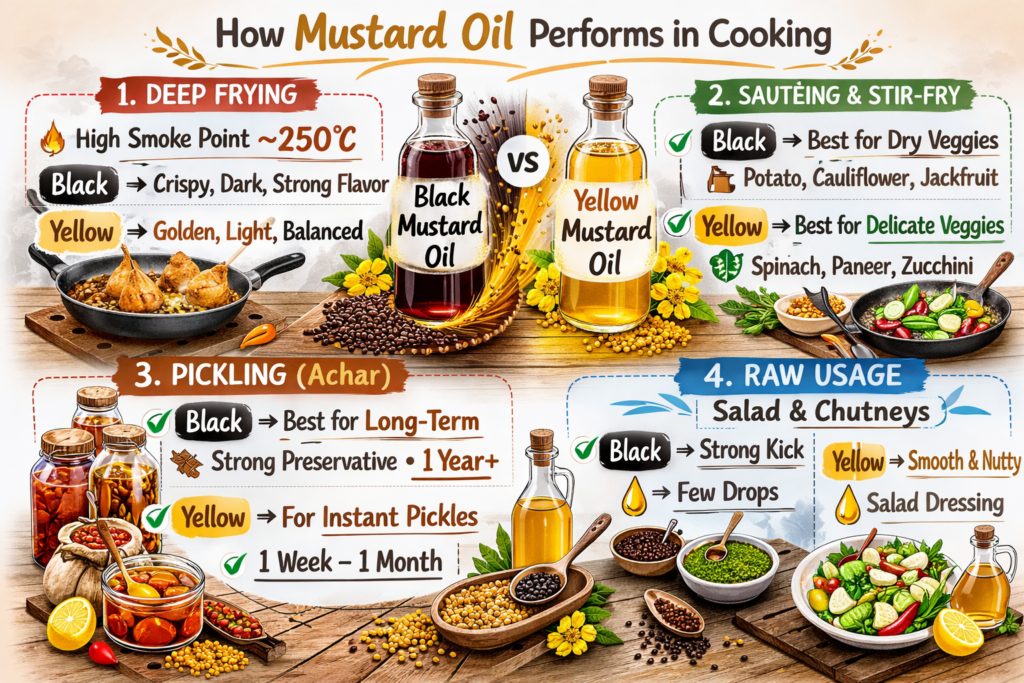
1. Deep frying
Mustard oil has a high smoke point (around 250°C), making it excellent for deep frying.
- Black mustard oil: Best for frying fritters (pakoras), fish, and samosas. It gives a dark, crispy crust. However, you must heat it until it smokes to remove the raw smell, otherwise, the food might taste bitter.
- Yellow mustard oil: Excellent for frying puris and snacks if you want them to look golden and bright rather than dark brown. It maintains the stability of the oil at high heat but keeps the flavour lighter.
2. Sautéing and stir-frying (Sabzi)
- Black mustard oil: Ideal for “dry” vegetables like potato fry, cauliflower, or jackfruit (kathal). These vegetables absorb the oil and the spicy flavour goes deep inside.
- Yellow mustard oil: Perfect for delicate vegetables like spinach, zucchini, or paneer dishes. It allows the natural sweetness of the vegetable to remain.
3. Pickling (Achar)
This is where black mustard oil is the undisputed champion. When we make mango pickle or mixed vegetable pickle that needs to sit in a jar for a year, we need a strong preservative.
- The high pungency of black mustard oil acts as a natural barrier against bacteria.
- The strong flavour matures over time, making the pickle taste better after months.
Yellow mustard oil can be used for “instant pickles” (which you eat within a week), but for long-term storage, black mustard oil is safer and tastier.
4. Raw usage (Salad dressings and chutneys)
- Black mustard oil: Only for those who love the “kick.” A few drops in a chutney can clear your sinuses!
- Yellow mustard oil: This is a fantastic salad dressing. If you mix yellow mustard oil with lemon juice, salt, and black pepper, it makes a healthy, Indian-style dressing for fresh salads. It is nutty and smooth, not stinging.
Regional preferences in India
India is not just one kitchen; it is millions of different kitchens.
Eastern India (Bengal, Bihar, Odisha, Assam): The preference here is heavily tilted towards strong Black Mustard Oil. The sharper, the better. In Bihar, the famous Litti Chokha is incomplete without a dip in raw black mustard oil.
Northern India (Punjab, Delhi, UP): Traditionally, black mustard oil was used. However, in recent years, there has been a massive shift. Many urban households in Delhi and Punjab are switching to Yellow Mustard Oil. Why? Because it feels lighter and suits the modern, sedentary lifestyle better than the heavy black oil.
Western India (Maharashtra, Gujarat): While peanut oil is king here, mustard oil is used for specific dishes. Since people here are not used to the strong smell, Yellow Mustard Oil is a much friendlier entry point for them. It allows them to enjoy the health benefits without the overpowering smell they are not used to.
Southern India: Mustard seeds are used for tadka, but mustard oil is not the primary cooking medium. However, health-conscious families in the South are now adopting Yellow Mustard Oil for sautéing because it blends well with curries without clashing with coconut flavours.
Storage, purity, and quality considerations
At OwnFresh, we cannot stress this enough: Purity is everything.
Whether you choose black or yellow, the oil must be pure. Unfortunately, the market is full of adulterated oils.
The problem with mixing
Many cheap mustard oils are mixed with palm oil or rice bran oil to lower the cost. Some are even chemically treated to artificially add the “pungent” smell using synthetic essence.
How to identify pure oil (The freezing test)
Here is a simple Dadi ma ka nuskha (Grandma’s trick) to check your oil: Put a small bowl of your mustard oil in the fridge (not the freezer) for a few hours.
- If it freezes or turns white and semi-solid, it is likely adulterated with palm oil.
- Pure mustard oil (black or yellow) stays liquid in the fridge. It might get a little thick, but it won’t freeze into a white block.
Storage tips
- Keep it dark: Light can break down the healthy fats in the oil. Always store your oil in a closed cupboard or a dark container.
- Keep it dry: Water is the enemy of oil. Ensure your spoon is dry before dipping it into the jar.
- Shelf life: Stone-Pressed oils are natural products without chemical preservatives. They are best used within 6 to 9 months of packing to get the best aroma and nutrition.
Why Kachi Ghani ( Stone-Pressed)?
You will often see “Kachi Ghani” written on OwnFresh bottles. This means the oil was extracted at low temperatures.
- Refined Mustard Oil: This is extracted using high heat and chemicals. It is colourless, odorless, and has lost most of its nutrition. Avoid this.
- Kachi Ghani: This preserves the natural antioxidants, the smell, and the taste. Whether you buy black or yellow, always insist on Kachi Ghani.
Which oil suits you? A quick guide for home cooks
Still confused? Let us simplify it based on what kind of cook you are.
Choose Black Mustard Oil if:
- You love traditional, rustic Indian flavours.
- You cook a lot of non-vegetarian curries (mutton, fish, chicken).
- You make traditional pickles at home.
- You want that authentic “dhaba style” taste in your vegetables.
- You live in a cold climate and want “warming” food.
Choose Yellow Mustard Oil if:
- You are health-conscious but find the smell of regular mustard oil too strong.
- You want to cook light, everyday meals (dal, sabzi) that don’t feel heavy.
- You are cooking for children or elders who prefer milder tastes.
- You want to use the oil for salad dressings or baking.
- You want to maintain the natural colour of your green vegetables.
Conclusion: the golden choice for your family
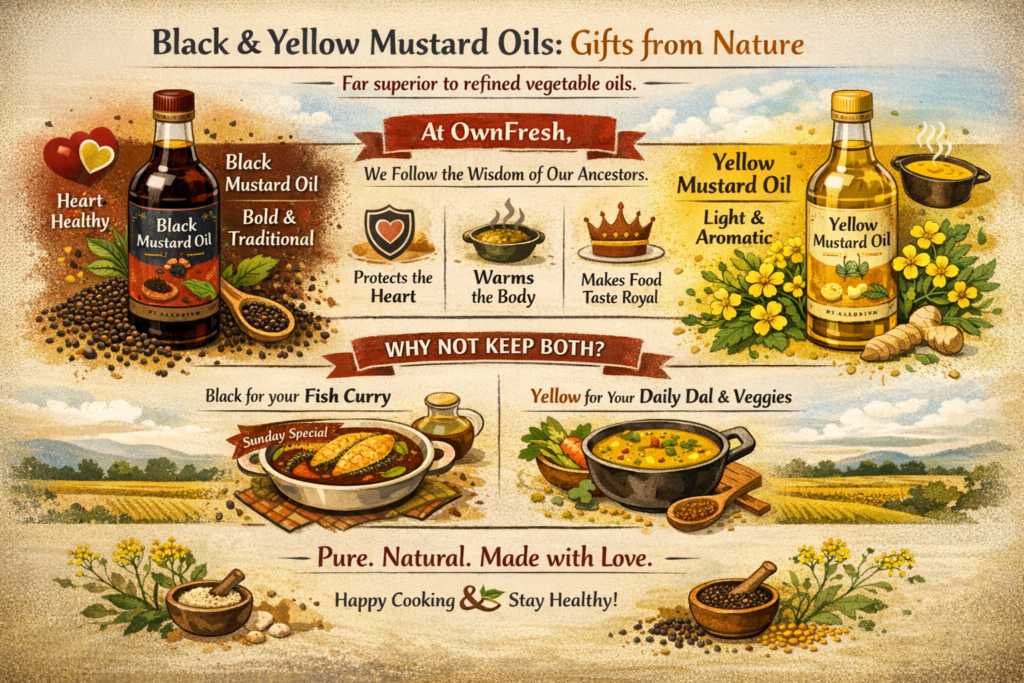
At the end of the day, both black and yellow mustard oils are gifts from nature. They are far superior to the highly refined, chemically treated vegetable oils that have flooded the market.
At OwnFresh, we believe in the wisdom of our ancestors. They knew that sarson ka tel was not just an ingredient; it was medicine. It protected the heart, warmed the body, and made simple food taste royal.
If you are a purist who loves the sharp zing of tradition, stick with the classic Black Mustard Oil. It is the bold choice for bold flavours.
If you are a modern home cook looking for a balance between tradition and lightness, Yellow Mustard Oil is your new best friend. It offers all the health benefits with a sophisticated, gentle aroma.
Why not keep a bottle of both? Use the black for your Sunday special fish curry and the yellow for your daily dal and veggies. That way, you get the best of both worlds.
Remember, the best oil is the one that is pure, natural, and made with love. Just like the food you cook for your family.
Happy cooking and stay healthy!
Frequently Asked Questions (FAQs)
1. Which mustard oil is better for heart health? Both oils are excellent for heart health as they are rich in Monounsaturated Fatty Acids (MUFA) and have a good Omega-3 to Omega-6 ratio. However, Yellow Mustard Oil is often considered slightly better for heart patients because it is lighter and easier to digest.
2. Can yellow mustard oil be used for deep frying? Yes, absolutely! Yellow mustard oil has a high smoke point, similar to black mustard oil. It is great for frying puris, pakoras, and snacks. The advantage is that it won’t darken the food as much as black mustard oil does, keeping your fried items looking golden and bright.
3. Is black mustard oil too strong for everyday cooking? It depends on your personal taste. For millions of families in North and East India, it is the standard daily oil. However, if you are not used to the pungency, it might feel strong. In that case, Yellow Mustard Oil is a better daily alternative as it is milder.
4. Which mustard oil is best for pickles? Black mustard oil is the best choice for traditional pickles (achar). Its strong pungency acts as a natural preservative and prevents fungus. It also provides the signature tangy taste that we love in Indian pickles.
5. Is there a nutritional difference between the two? The nutritional profile is very similar. Both are rich in healthy fats. However, Yellow Mustard Oil generally retains slightly more natural antioxidants (Vitamin E) and is lighter in texture. Black mustard oil has stronger antibacterial properties due to its higher pungency.
6. Do I need to heat yellow mustard oil to the smoking point? Unlike black mustard oil, which needs to be heated until it smokes to remove the raw, stinging smell, yellow mustard oil does not necessarily need this step. Since it has a mild, nutty aroma, you can cook with it directly without overheating it, which helps preserve its nutrients.
7. Can I use mustard oil for massage? Yes! Black mustard oil is traditionally used for body massage, especially for babies and elders in winter, as it generates heat. Yellow mustard oil can also be used; it is excellent for skin health and is less sticky, making it a good choice if you don’t want a strong smell on your skin.
8. How do I know if my mustard oil is pure? Pure mustard oil (black or yellow) will cause a tingling sensation in your nose if you smell it deeply (more so for black). Also, if you put a small amount in the fridge, it should remain liquid. If it freezes or turns white, it is likely mixed with palm oil. Always choose a trusted brand like OwnFresh that guarantees Kachi Ghani purity.