When you walk past a bustling Indian restaurant or a roadside dhaba, the first thing that hits you is not the sight of the food, but the unforgettable aroma. It is the rich, warm scent of spices sizzling in a hot pan, an aroma that instantly makes your mouth water and draws you inside. Have you ever wondered why the food at these authentic eateries tastes so incredibly rich, perfectly balanced, and distinctly traditional? While secret spice blends and expert chefs certainly play a big part, there is a silent hero working behind the scenes in every great Indian kitchen. That hero is the cooking oil.
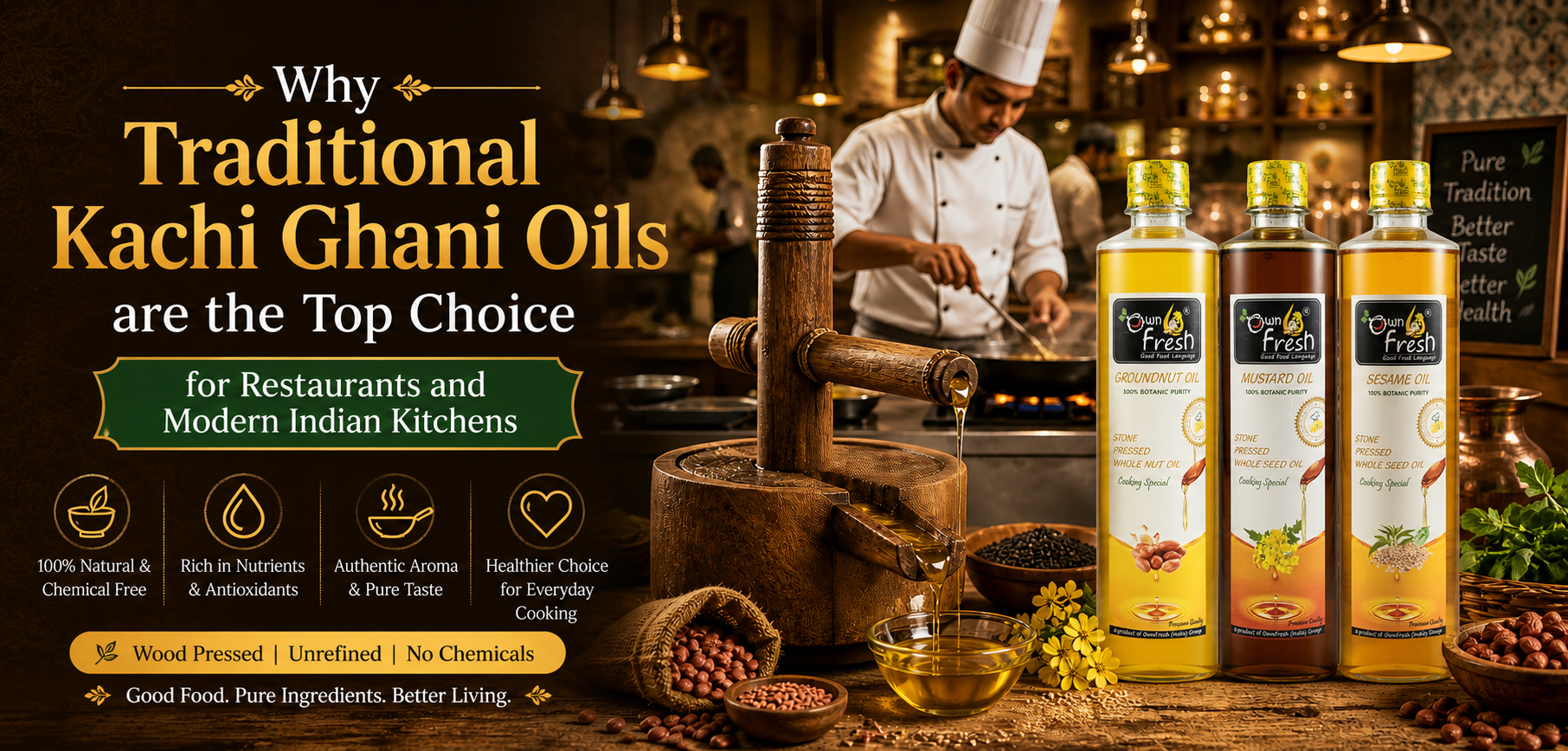
For decades, modern kitchens shifted towards clear, refined, and heavily processed oils because they were marketed as light and modern. However, a massive shift is happening right now in the culinary world. Top restaurant chefs, smart dhaba owners, and mindful home cooks are returning to the roots of Indian cooking. They are bringing back traditional kachi ghani oils to their kitchens. But why is this happening? Why are people willingly stepping away from clear refined oils and choosing thick, fragrant, unrefined traditional oils instead?
The answer lies in the deep connection between authentic Indian flavours, nutritional quality, and the pure joy of eating wholesome food. Let us dive deep into understanding why traditional kachi ghani oils are becoming the absolute preferred choice for anyone who values real taste and healthier cooking.
Table of Contents
The soul of authentic Indian food lies in its cooking oil
In Indian cuisine, cooking oil is never just a medium to stop food from sticking to the pan. It is considered an active, living ingredient. In many western cuisines, chefs try to use oils that have absolutely no flavour so that the taste of the meat or vegetables stands entirely alone. Indian cooking works on a completely different philosophy. In our kitchens, the oil is the very foundation of the dish.
Think about how we build a curry. We heat the oil and drop in whole spices like cumin, mustard seeds, cloves, and cardamom. The oil captures the essential oils released by these spices. It acts as a carrier, absorbing the soul of the spices and distributing that incredible flavour evenly throughout the entire dish. If the foundation itself is a weak, heavily processed, flavourless refined oil, the final dish will always lack that authentic depth. Traditional oils, on the other hand, bring their own character to the pot. They have a rich history, a beautiful natural colour, and a fragrance that tells a story of purity.
What exactly does kachi ghani mean in simple language?
If you grew up in an Indian household, you have probably heard your grandparents use the term kachi ghani, especially when talking about mustard oil, groundnut oil, or sesame oil. But what does it actually mean?
The term can be broken down into two simple words. “Kachi” translates to raw or cold, and “ghani” refers to the traditional wooden or stone press used to crush seeds and extract oil. Put simply, kachi ghani refers to oil that is extracted from seeds at a normal, room temperature without the use of any extreme heat or harmful chemicals.
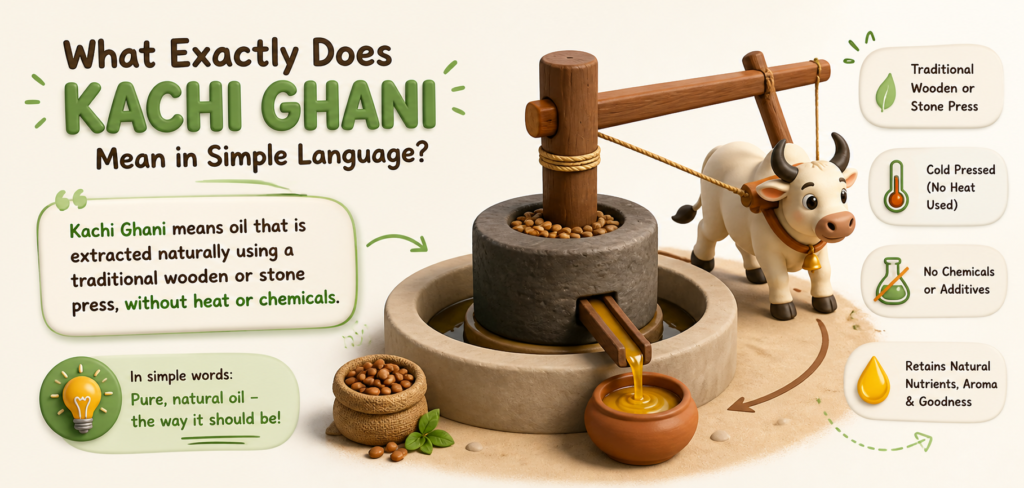
Hundreds of years ago, a ghani was usually a heavy wooden mortar and pestle driven slowly by bullocks walking in a circle. The slow speed was very important. Because the grinding happened so slowly, it did not create any harsh friction. Without friction, there was no heat generated. Today, modern machinery has replaced the bullocks, but the authentic kachi ghani process remains exactly the same at its core. The seeds are still crushed slowly in a wooden or stone press, ensuring that the temperature never rises to a level that would destroy the natural goodness of the oil.
The traditional extraction process and why it matters today
To truly understand why chefs and families are choosing kachi ghani oil, you need to understand how drastically different the traditional extraction process is from modern oil refining.
When you extract oil the traditional way, you take high-quality, sun-dried seeds. These could be mustard seeds, peanuts, or sesame seeds. You place them into the stone or wooden press. The heavy press slowly rotates, crushing the seeds and gently forcing the natural oil out of them. That is the entire process. The oil is then allowed to rest so that any fine seed particles settle at the bottom, and the pure, unfiltered oil is bottled. Because no external heat is applied during this pressing, the oil retains all of its natural vitamins, antioxidants, and essential fatty acids. This is why it is often called cold-pressed oil.
Now, compare this pure, gentle method to how commercial refined oils are made in massive factories. To get every last drop of oil out of a seed, large commercial companies use extreme heat, sometimes up to 200 degrees celsius. But heat alone is not enough for them. They wash the crushed seeds with a petroleum-based chemical solvent called hexane to extract the remaining oil. After that, the oil looks dark and smells harsh because of the extreme processing. So, they send it through further chemical processes to bleach away the natural colour and deodorise away the natural smell.
What you are left with in a bottle of refined oil is a liquid that has been stripped of its natural identity, its nutrients, and its soul. It looks like clear water and has no smell. When you understand this massive difference in how the oils are made, it becomes very clear why anyone who cares about the purity of their food would strongly prefer the traditional, stone-pressed kachi ghani method. The traditional process respects the ingredient, while the industrial process tortures it.
Why restaurants focus so heavily on cooking oil quality
You might think that restaurants only care about cutting costs and making the highest profit possible. While that might be true for cheap fast-food chains, high-quality authentic restaurants, heritage dhabas, and premium modern Indian eateries think very differently. They know that the secret to long-term success in the food business is consistent, unforgettable taste. And they know that you cannot achieve that taste with cheap ingredients.
For a restaurant, cooking oil is one of the highest volume ingredients they purchase. They use it for tempering dals, frying snacks, making gravies, and marinating tandoori dishes. Experienced chefs understand that if they compromise on their cooking oil, the quality of every single dish on their menu will instantly drop.
When a restaurant chooses to invest in high-quality kachi ghani oil, they are making a conscious decision to elevate their food. They know that a premium stone-pressed mustard oil or groundnut oil will give their curries a richer mouthfeel. They know that customers may not be able to point out exactly what makes the food taste so good, but they will recognise the feeling of satisfaction after eating it. The oil is the silent partner in the kitchen that makes the chef’s hard work shine.
How kachi ghani oil transforms aroma, flavour, and texture
The sensory experience of eating Indian food involves sight, smell, and taste. Traditional kachi ghani oils dramatically improve all three of these areas.
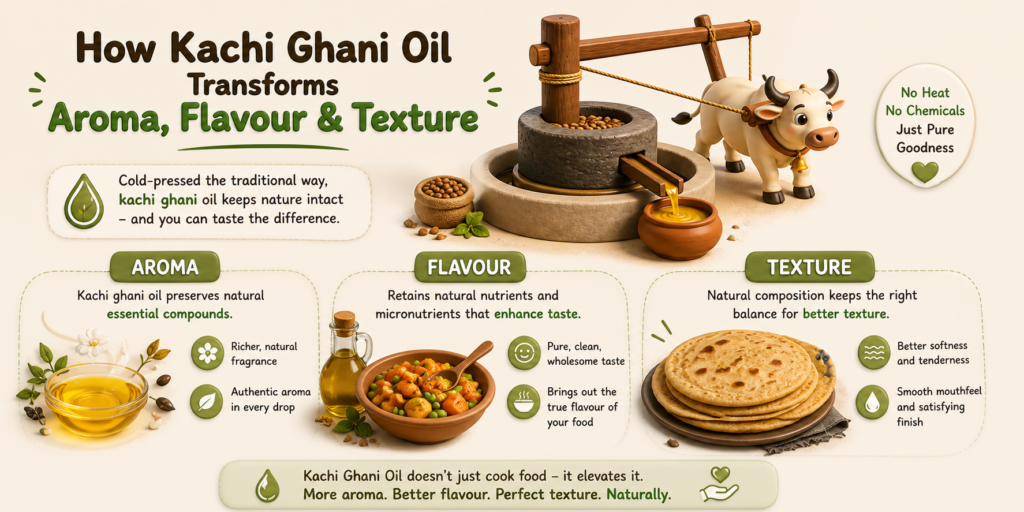
Let us talk about aroma first. If you heat pure kachi ghani mustard oil in a pan, it releases a sharp, pungent aroma that clears your sinuses and instantly makes you feel hungry. It smells earthy and real. When you temper cumin seeds and dry red chillies in this oil, the aroma that fills the kitchen is deeply intoxicating. Refined oils simply cannot do this because their natural aroma was chemically removed during the deodorisation process.
Next is the flavour. Traditional oils carry the authentic, nutty, and robust flavours of the seeds they were pressed from. Groundnut oil adds a beautiful, mild sweetness and nuttiness to southern and western Indian dishes. Sesame oil brings a deep, rich, toasted flavour. When you cook vegetables or meat in these oils, the oil wraps around the ingredients, enhancing their natural tastes rather than just making them greasy. The oil itself acts like a spice, adding a layer of complexity to the flavour profile of the dish.
Finally, there is texture, which chefs call mouthfeel. Kachi ghani oils are naturally thicker and more viscous than refined oils. When you make a rich gravy using stone-pressed oil, the oil emulsifies beautifully with the onion, tomato, and cashew pastes. It creates a gravy that is incredibly smooth, velvety, and luxurious on the tongue. Refined oils often separate easily from the gravy, leaving a watery, thin, and unappealing layer of grease floating on top of the dish.
The deep importance of high smoke point in commercial cooking
One of the most critical technical reasons why professional chefs choose certain oils is a concept called the smoke point.
The smoke point is the exact temperature at which an oil stops shimmering and starts burning, releasing a continuous bluish smoke. When an oil reaches its smoke point, its chemical structure begins to break down. It starts releasing harmful free radicals and a toxic chemical called acrolein, which is what gives burnt food that bitter, acrid taste.
Indian cooking involves a lot of high-heat techniques. Whether we are doing a fast stir-fry in a wok, deep-frying pooris until they puff up, or dropping wet spices into screaming hot oil for a tadka, our oil needs to be able to handle serious heat without burning.
Traditional kachi ghani oils, especially mustard oil and groundnut oil, naturally have very high and stable smoke points. They can withstand the intense heat of a commercial restaurant burner without breaking down. This means a chef can get the oil hot enough to instantly crisp up a samosa or safely temper delicate spices without ruining the nutritional value of the oil or introducing bitter, burnt flavours into the food. The stability of these natural oils under high heat is a massive advantage in a busy, fast-paced restaurant kitchen.
The real difference between refined oils and traditional kachi ghani oils
To make the best choices for our families and our businesses, we need to clearly understand the differences between these two types of oils. It is not just about nostalgia; there is hard science and practical cooking experience behind the shift back to traditional oils.
The first major difference is nutritional value. Because kachi ghani oils are extracted without heat, they retain their natural antioxidants, like vitamin E, and their healthy fats. These natural compounds are great for heart health, skin health, and overall immunity. Refined oils lose almost all of these beneficial nutrients during the extreme heating and chemical washing phases of their production.
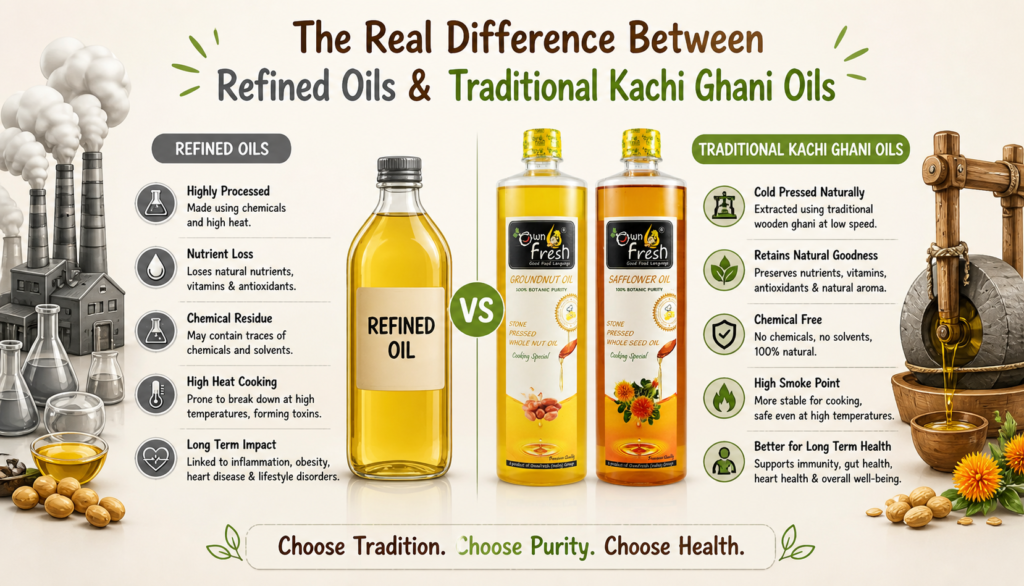
The second difference is the presence of trans fats and harmful chemicals. Traditional stone-pressed oils are completely pure. Nothing is added, and nothing is taken away. The pressing process is entirely mechanical. Refined oils, however, are exposed to chemical solvents, synthetic anti-foaming agents, and chemical preservatives to give them an unnatural shelf life. Sometimes, the extreme heat of the refining process can even create small amounts of unhealthy trans fats.
The third difference is how they behave in the pan. Have you ever noticed that when you deep fry in refined oil, the food tends to absorb a lot of the oil, becoming heavy and soggy? This happens because the molecular structure of the oil has been degraded. Traditional kachi ghani oils, because of their natural, unbroken structure, coat the outside of the food quickly, forming a crispy barrier. This prevents the food from absorbing too much oil, resulting in lighter, crispier, and much less greasy fried foods.
Why expert chefs trust natural oils for consistent large-scale cooking
If you run a restaurant, consistency is everything. If a customer loves your chicken curry on a tuesday, they expect it to taste exactly the same when they bring their friends back on a saturday. Achieving this level of consistency when you are cooking massive batches of food for hundreds of people is a huge challenge.
Chefs rely on ingredients that behave predictably. Traditional kachi ghani oils offer incredible stability. When a chef makes a massive pot of base gravy (the onion-tomato masala used as a base for many dishes) using kachi ghani oil, the natural preservatives and antioxidants in the unrefined oil actually help preserve the gravy. The flavours meld together perfectly over time.
Furthermore, during large-scale cooking, the kitchen environment is very hot. Some highly processed oils can oxidise quickly when left open in a hot kitchen, developing a slightly stale or rancid smell. High-quality traditional oils, especially mustard oil, have natural antibacterial and antifungal properties. They remain stable and fresh-tasting even in the demanding, high-pressure environment of a commercial kitchen. Chefs value this reliability. They need an oil that works as hard as they do.
The connection between natural oils, authentic taste, and happy customers
At the end of the day, a restaurant survives on customer satisfaction. In India, people have a very deep, emotional connection to food. We know what real food is supposed to taste like because we carry the taste memories of our mothers’ and grandmothers’ cooking in our minds.
When a customer goes to a restaurant and eats a dish cooked in pure kachi ghani oil, it triggers those deep memories. The pungent hit of mustard oil in a fish curry, or the comforting aroma of groundnut oil in a vegetable poriyal, signals to the brain that this food is authentic. It tells the customer that the chef respects the tradition of the cuisine.
Refined oils simply cannot replicate this experience. Food cooked in refined oil often tastes flat and commercial. It might look good, but it lacks a soul. Customers might eat it, but they will not crave it. Restaurants that use traditional oils notice a higher rate of returning customers. The food leaves a lasting impression. People recommend the place to their friends, saying, “The food there tastes like home.” That is the ultimate compliment for any chef, and it is largely made possible by choosing pure, natural cooking mediums.
Common restaurant cooking mistakes caused by poor oil choices
Even a highly skilled chef will struggle if they are forced to use poor quality ingredients. Many common complaints about restaurant food can be directly traced back to the use of cheap, low-quality refined oils.
One of the most common complaints is that restaurant food is too heavy and causes acidity or bloating. While heavy cream and excess spices can cause this, a major culprit is the oil. Cheap refined oils break down easily and become sticky. When food absorbs this sticky, broken-down oil, it becomes very difficult for the human digestive system to process. Traditional oils, with their healthy fat profiles, are digested much more efficiently by the body.
Another massive mistake is the poor reusing of oil. In commercial kitchens, frying oil is naturally reused to fry multiple batches of food. When you repeatedly heat a chemically refined oil, its quality degrades extremely fast. It turns black, smokes at lower temperatures, and ruins the taste of the food. While no oil should be reused indefinitely, pure kachi ghani oils have a much higher thermal stability. They hold up significantly better to the stress of frying, ensuring that the last batch of samosas tastes just as fresh and crispy as the very first batch.
Finally, poor oil choices lead to a loss of flavour over time. Have you ever ordered takeout, only to find that by the time you bring it home, the gravy has separated and tastes completely bland? Highly processed oils do not bind well with spices. As the food cools down, the oil separates and the spices lose their punch. Pure traditional oils bind beautifully with masalas, trapping the flavours so the food tastes incredible even when eaten later.
How you can apply restaurant-quality cooking practices at home
You do not need a commercial kitchen or a degree in culinary arts to cook incredible, authentic Indian food. By simply observing why restaurants choose kachi ghani oils and applying those principles in your own kitchen, you can completely transform your daily meals.
The first step is to switch your base cooking oil. Remove the clear, heavily processed refined oils from your pantry and bring in pure, stone-pressed kachi ghani oils. Depending on where you live in India and what you cook, you might choose mustard oil for northern and eastern dishes, groundnut oil for western and southern dishes, or sesame oil for specific traditional recipes.

The second practice is mastering temperature control. If you are using kachi ghani mustard oil, remember the traditional restaurant technique of taking it to the smoking point before adding ingredients. You heat the mustard oil until pale white smoke appears, then you turn off the heat and let it cool down slightly before adding your cumin seeds or onions. This ancient technique removes the raw bite of the mustard oil, leaving behind a smooth, sweet, and nutty flavour that forms the perfect base for your curries.
The third practice is matching the oil to the region of the dish. A major secret of great chefs is that they respect regionality. If they are making a traditional Punjabi chole, they will use mustard oil. If they are making a Maharashtrian batata bhaji, they will reach for groundnut oil. Using the right traditional oil for the right regional dish is the easiest way to replicate that authentic restaurant taste at home.
Classic Indian dishes that need kachi ghani oil for true flavour
To truly appreciate the magic of traditional extraction, you have to look at the food itself. Some dishes in the Indian culinary repertoire absolutely demand the use of kachi ghani oil. If you try to make them with refined oil, they will simply fail to deliver the expected taste.
Making curries and rich gravies
Think of a classic dhaba-style dal makhani, a robust mutton rogan josh, or a homestyle aloo matar. These gravies require slow cooking. The onions need to be deeply caramelised, and the tomatoes need to be cooked down until the oil separates from the masala. When you do this slow-roasting (bhunao) process with pure kachi ghani oil, the oil infuses with the sweet onions and tart tomatoes, creating a thick, incredibly flavourful base. The natural colour of the oil also gives the curry a vibrant, appetising look without needing artificial food colouring.
Creating the perfect magical tadka
The tadka, or tempering, is the crowning glory of Indian cooking. It is the final step where hot oil infused with spices is poured over a finished dish like dal or chutney. The sizzle when the hot oil hits the wet dal is music to a food lover’s ears. The oil used for tadka must be rich and aromatic. A tadka done in kachi ghani mustard oil with garlic, dry red chillies, and asafoetida (hing) will completely elevate a simple bowl of yellow dal into a restaurant-quality masterpiece. The aroma of a pure traditional oil tadka can wake up an entire household.
Frying crispy snacks and street food favourites
Indian street food is legendary, and almost all of it involves deep-frying. Think of crispy samosas with a flaky crust, golden pakoras bursting with onion and spices, or fluffy bhaturas. Street food vendors who are famous for their taste still rely on traditional unrefined oils. Kachi ghani groundnut oil is highly prized for frying because of its high smoke point and mild flavour. It makes the outside of the pakora shatteringly crisp while keeping the inside soft and perfectly cooked, without leaving a heavy, oily residue on your fingers.
Preserving traditional homemade pickles
No Indian meal is complete without a spoonful of tangy, spicy achaar. Making pickles is an ancient art in Indian homes. Whether it is a spicy raw mango pickle or a fiery green chilli pickle, the main preservative used is pure kachi ghani mustard oil. Refined oils can never be used for pickling because they lack the natural antibacterial properties and the strong flavour required to preserve the vegetables and spices over many months. The pure mustard oil acts as a protective blanket, maturing the spices and ensuring the pickle stays safe and delicious for years.
How OwnFresh brings this pure tradition to your kitchen
We understand that finding truly pure, unadulterated traditional oil in today’s modern supermarket can be very difficult. The shelves are flooded with cleverly marketed refined oils and fake blends that use chemical essences to mimic the smell of real mustard or groundnut.
That is exactly why OwnFresh exists. OwnFresh is built on the core values of absolute purity, traditional stone-pressed extraction, and a deep love for authentic Indian cooking. We believe that your family deserves the exact same high-quality, nutrient-rich ingredients that our ancestors used.
When you choose an OwnFresh product, you are not just buying a cooking oil. You are bringing home a product that has been crafted with patience and respect for nature. We strictly follow the traditional kachi ghani method, using only the highest quality seeds, stone-pressing them slowly without any heat, and bottling the pure, unfiltered goodness. We do not use chemicals, we do not bleach our oils, and we never compromise on nutritional quality. Our goal is simple: to help you bring back the authentic taste of real Indian food to your dining table, while protecting the health of your loved ones.
Final thoughts on returning to our roots
The movement away from factory-made refined oils and back toward traditional kachi ghani oils is not just a passing food trend. It is a necessary correction. Restaurants and smart chefs were among the first to realise that you cannot create soul-satisfying, authentic Indian food using heavily processed ingredients. Now, home kitchens across the country are waking up to this truth.
Choosing traditional stone-pressed oil is a choice that benefits everything. It improves the aroma in your kitchen, it transforms the flavour and texture of your daily meals, and most importantly, it protects your health by providing natural, uncorrupted nutrition.
Cooking is an act of love, and the ingredients we choose are a reflection of that care. By returning to the traditional kachi ghani oils that our grandmothers trusted, we are not just cooking better food; we are preserving our rich culinary heritage for the generations to come. So, the next time you heat up a pan to make a simple dal or a grand sunday feast, make sure the oil you pour into it is pure, natural, and full of life. Your tastebuds, and your body, will thank you for it.
FAQs
Why do restaurants prefer kachi ghani oil?
Restaurants prefer kachi ghani oil because it deeply enhances the authentic aroma, flavour, and texture of traditional Indian dishes. It also has a high smoke point, making it highly stable for commercial kitchen cooking, and it helps maintain a consistent, rich taste that keeps customers coming back.
Is kachi ghani oil suitable for deep frying?
Yes, absolutely. Pure kachi ghani oils, especially groundnut and mustard oil, have naturally high smoke points. They can handle the intense heat of deep-frying without breaking down or releasing harmful chemicals, resulting in crispy, less greasy snacks.
How is kachi ghani oil different from refined oil?
Kachi ghani oil is extracted slowly using a traditional wooden or stone press without any heat or chemicals, keeping all its natural nutrients and flavours intact. Refined oil is extracted using extreme heat and chemical solvents (like hexane), and is then bleached and deodorised, stripping it of its natural health benefits and taste.
Which Indian dishes taste better with traditional oils?
Almost all authentic Indian dishes taste significantly better with traditional oils. Heavy curries like dal makhani, meat gravies, crispy fried snacks like samosas, everyday vegetable stir-fries, traditional pickles (achaar), and aromatic tadkas all rely on pure kachi ghani oil for their true, intended flavour.
Does traditional oil retain more nutrients?
Yes. Because the kachi ghani (cold-pressed) method does not use any high heat during extraction, the natural antioxidants, essential fatty acids, and vitamins (like Vitamin E) present in the seeds are fully retained in the final oil, making it far healthier for daily consumption.
Can kachi ghani oil be used daily at home?
Yes, kachi ghani oil is perfect for daily home cooking. Whether you are making breakfast upma, a simple afternoon dal, or a dinner curry, replacing your processed refined oil with pure, traditional stone-pressed oil is one of the easiest ways to improve your family’s daily nutrition and the taste of your homemade meals.